Explanation
Hongos micorrícicos arbusculares: intercambio de recursos con las raíces
Una mirada acotada a cómo los hongos micorrícicos arbusculares intercambian carbono y nutrientes con las plantas, y a lo que los métodos de trazado permiten afirmar sobre ese proceso.
La asociación: recursos en dos direcciones
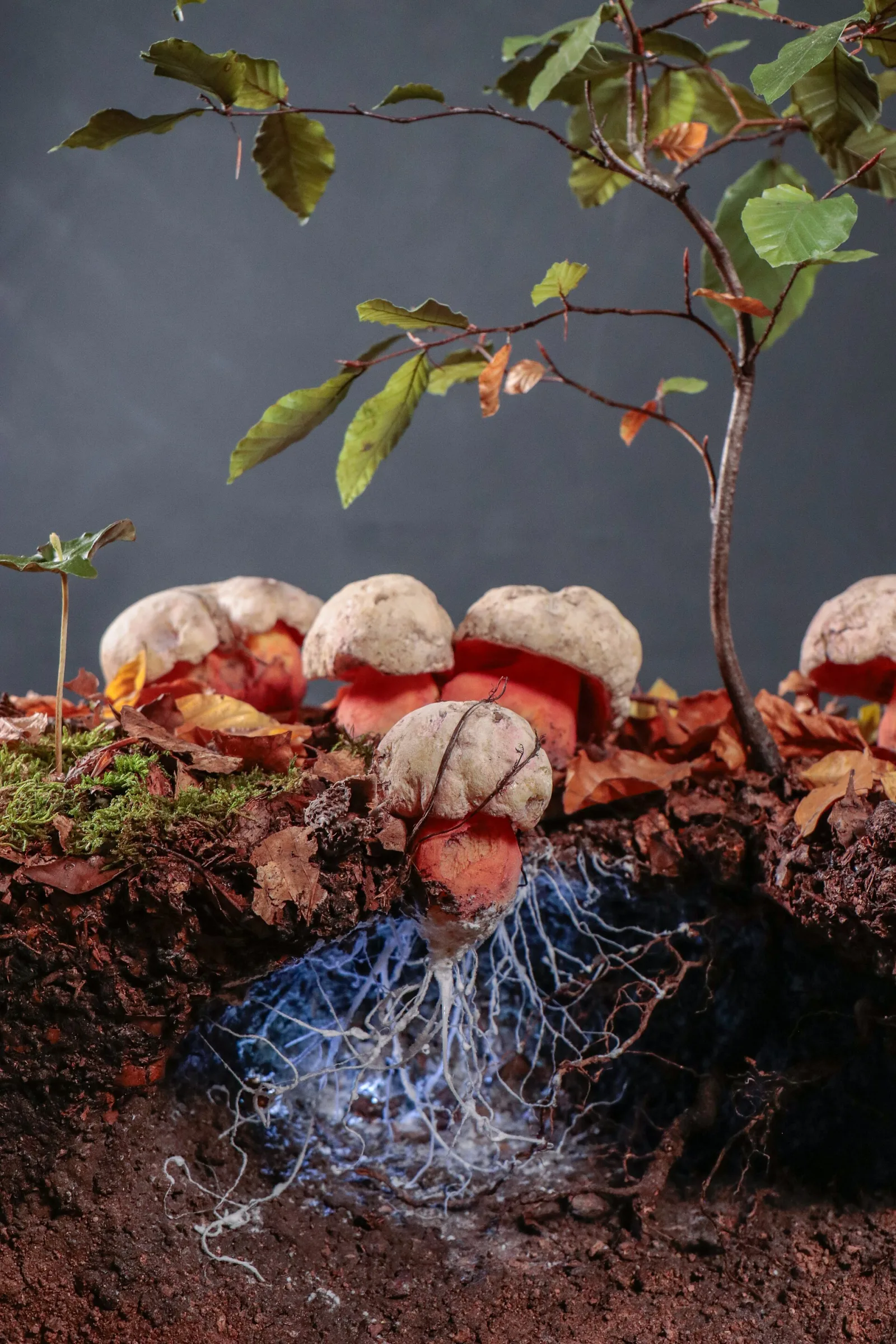
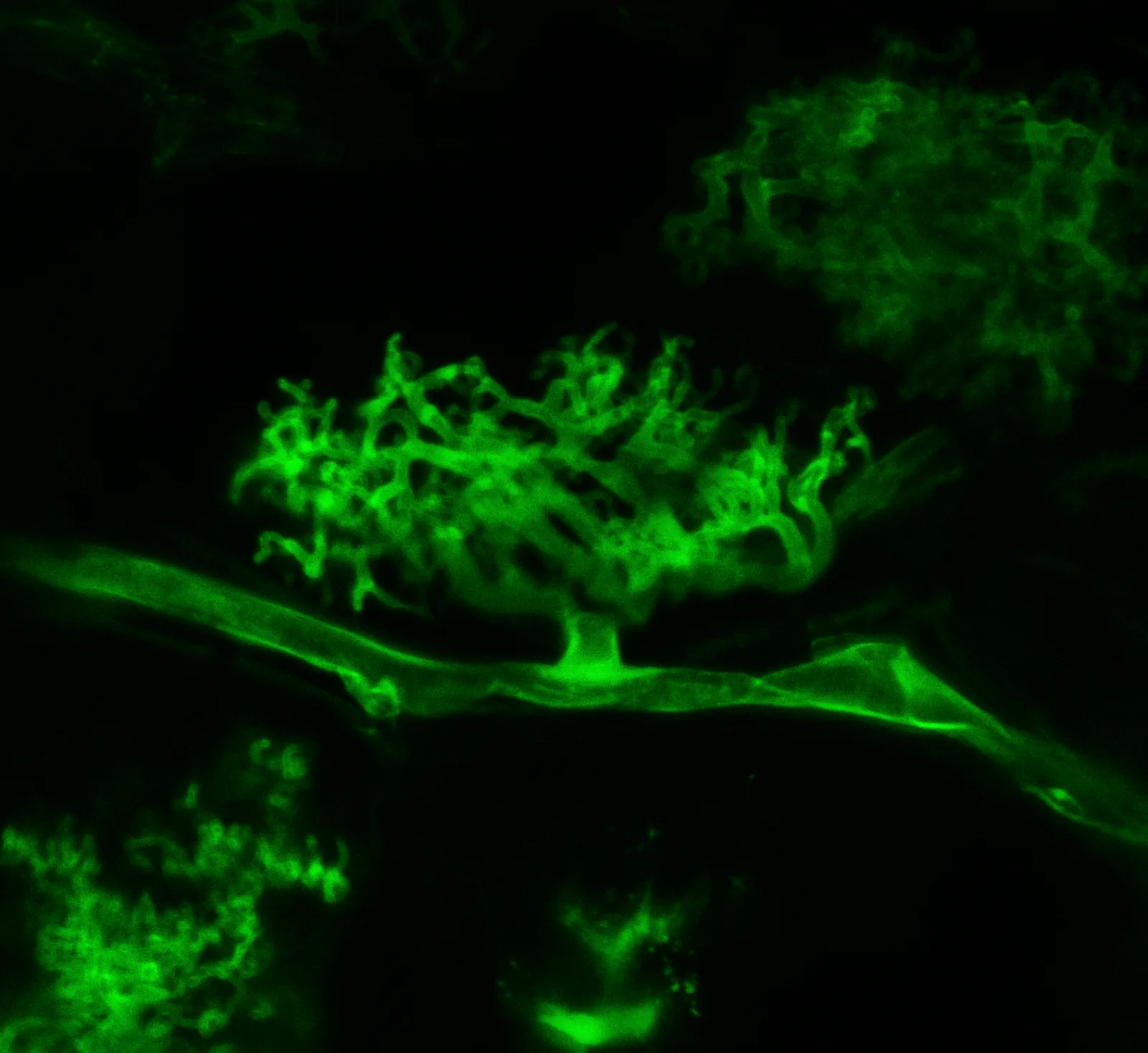
Los hongos micorrícicos arbusculares colonizan raíces y establecen una vía de intercambio: la planta aporta carbono procedente de la fotosíntesis y el hongo puede transportar nutrientes del suelo, entre ellos fósforo, nitrógeno y zinc. Es una descripción de la asociación, no una garantía de que todas las plantas reciban la misma cantidad de cada recurso [310].
Cómo ayudan las hifas
Las hifas fúngicas se prolongan desde las raíces hacia el suelo y aumentan el contacto del sistema raíz-suelo. Esa extensión ofrece una explicación de cómo el hongo puede contribuir a la captación de agua y nutrientes; la síntesis del Servicio Forestal de Estados Unidos destaca especialmente nitrógeno y fósforo, pero no establece una magnitud universal del efecto [320, 323].
Qué observan los métodos de trazado
Una forma de poner a prueba el transporte consiste en separar un compartimento de suelo con una malla que deja pasar hifas, pero no raíces, y marcar allí un nutriente con un isótopo. Si la marca aparece después en la planta, permite detectar el transporte por la vía micorrícica. Estos diseños han servido para demostrar el transporte en ambas direcciones, aunque los resultados corresponden a las condiciones y organismos estudiados [310].
No confundir vías de entrada de carbono
Parte del carbono recién fijado por la planta puede llegar al suelo mediante los hongos asociados a la raíz; otra vía es la liberación directa de compuestos por las raíces. Un estudio que comparó ambas rutas las trata como procesos distintos relacionados con la disponibilidad de nutrientes. Por eso, no todo carbono detectado en el suelo puede atribuirse sin más a las micorrizas [310, 311].
Variación y límites de lo que puede concluirse
El intercambio no es una cifra fija aplicable a cualquier asociación. La revisión de estudios con trazadores recoge diferencias entre cultivares: en trigo, la contribución de la vía micorrícica al fósforo dependió de la variedad; en cebada, también se describieron diferencias entre cultivares en el transporte de nitrógeno. Estos ejemplos impiden convertir el mecanismo en una promesa uniforme para todas las plantas y suelos [310].
Interpretación e hipótesis, no una conclusión general
La interpretación respaldada aquí es acotada: en las asociaciones estudiadas, el hongo puede facilitar el transporte de recursos a la planta y recibe carbono a cambio. Que esta capacidad contribuya siempre a la sostenibilidad de sistemas naturales o agrícolas es una posibilidad que requiere evaluarse en contextos concretos; la revisión señala que hacen falta estudios bien diseñados para valorar ese potencial [310].
Fuentes y método
Esta historia sintetiza las referencias indicadas y distingue observaciones posibles de conclusiones que exigirían más datos. No presenta trabajo de campo original de FaunaGuide ni sustituye una identificación experta.
- Diversity of arbuscular mycorrhizal fungi in University of Port Harcourt, Port Harcourt in Southern Nigeria. — Diversity of arbuscular mycorrhizal fungi in University of Port Harcourt, Port Harcourt in Southern Nigeria. | The Bioscientist Journal Article Sidebar PDF Published: May 12, 2026 DOI: https://doi.org/10.54117/the_bioscientist.v14i2.212 Keywords: Mycorrhi
- Arbuscular mycorrhizal fungi contribute to wheat yield in an agroforestry system with different tree ages — Frontiers | Arbuscular mycorrhizal fungi contribute to wheat yield in an agroforestry system with different tree ages Intercropping achieved through agroforestry is increasingly being recognized as a sustainable form of land use. In agroforestry, the root
- Long-term N addition reduced the diversity of arbuscular mycorrhizal fungi and understory herbs of a Korean pine plantation in northern China — Frontiers | Long-term N addition reduced the diversity of arbuscular mycorrhizal fungi and understory herbs of a Korean pine plantation in northern China With the development of agriculture and industry, the increase in nitrogen (N) deposition has caused
- Track and trace: how soil labelling techniques have revealed the secrets of resource transport in the arbuscular mycorrhizal symbiosis. — Track and trace: how soil labelling techniques have revealed the secrets of resource transport in the arbuscular mycorrhizal symbiosis - PMC Arbuscular mycorrhizal (AM) fungi colonise plant roots, and by doing so forge the ‘mycorrhizal uptake pathway(s)’
- Exploring the transfer of recent plant photosynthates to soil microbes: mycorrhizal pathway vs direct root exudation. — Exploring the transfer of recent plant photosynthates to soil microbes: mycorrhizal pathway vs direct root exudation - PMC Plants rapidly release photoassimilated carbon (C) to the soil via direct root exudation and associated mycorrhizal fungi, with both
- Mycorrhizae and grapevines: the known unknowns of their interaction for wine growers' challenges. — Mycorrhizae and grapevines: the known unknowns of their interaction for wine growers’ challenges - PMC Arbuscular mycorrhizal fungi (AMF) play an important role in grapevine production systems. However, little is known about how this relationship is achie
- Mycorrhiza — A mycorrhiza (from Ancient Greek μύκης (múkēs) 'fungus' and ῥίζα (rhíza) 'root'; pl. mycorrhizae, mycorrhiza, or mycorrhizas) is a symbiotic association between a fungus and a plant, in which fungal hyphae and plant roots become interconnected and form an
- Mycorrhizal fungi and soil carbon storage — Soil carbon storage is an important function of terrestrial ecosystems. Soil contains more carbon than plants and the atmosphere combined. Understanding what maintains the soil carbon pool is important to understand the current distribution of carbon on E
- What are mycorrhizal fungi? | Kew — What are mycorrhizal fungi? | Kew Hidden beneath your feet, meet the fungi living within plant roots, and how Kew is studying these incredible species. 27 August 2025 7 min watch What are mycorrhizal fungi? Hidden beneath your feet, meet the fungi living
- Getting to the Root of the Solution - AgResearch Magazine — USDA ARS Online Magazine Vol. 54, No. 1 United States Department of Agriculture AgResearch Magazine ARS Home l About ARS l Contact ARS Search AgResearch Mag Jan 2006 - Contents PDF Previous Story Next Story Getting to the Root of the Solution Technician J
- Publication : USDA ARS — Publication : USDA ARS ARS Home » Northeast Area » Beltsville, Maryland (BARC) » Beltsville Agricultural Research Center » Sustainable Agricultural Systems Laboratory » Research » Publications at this Location » Publication #307387 ARS-wide ARS National P
- Mycorrhizae | US Forest Service Research and Development — Mycorrhizae | US Forest Service Research and Development T T T Articles Data and Tools Publications Treesearch Understory National Forest Service Library Multimedia Treesearch Mycorrhizae Informally Refereed Authors: Martin Jurgensen, Dana Richter, Carl C
- Mycorrhizae in forest tree nurseries | US Forest Service Research and Development — Mycorrhizae in forest tree nurseries | US Forest Service Research and Development T T T Articles Data and Tools Publications Treesearch Understory National Forest Service Library Multimedia Treesearch Mycorrhizae in forest tree nurseries Informally Refere
- Soil Fungi Critical to Organic Success - AgResearch Magazine — USDA ARS Online Magazine Vol. 49, No. 5 United States Department of Agriculture AgResearch Magazine ARS Home l About ARS l Contact ARS Search AgResearch Mag May 2001 - Contents PDF Previous Story Next Story Soil Fungi Critical to Organic Success Micrograp
- USDA ARS Online Magazine Vol. 58, No. 10 — USDA ARS Online Magazine Vol. 58, No. 10 United States Department of Agriculture AgResearch Magazine ARS Home l About ARS l Contact ARS Search AgResearch Mag Nov 2010 - Contents PDF Previous Story Next Story Infrared Sheds Light on Beneficial Microbes Inf
- How hidden fungi help us grow veg | Kew — How hidden fungi help us grow veg | Kew There's an underground world hidden in the soil which is essential for growing strong, healthy vegetables. 16 January 2020 3 min read How hidden fungi help us grow veg There's an underground world hidden in the soil
- Agricultura ecológica — La agricultura ecológica, orgánica o biológica es un sistema de cultivo de una explotación agrícola basada en la utilización óptima de los recursos naturales, sin emplear productos químicos sintéticos u organismos genéticamente modificados (OGMs) en ning
- Adventice — Une adventice (du latin adventicius, « qui vient de l'extérieur ») désigne pour les agriculteurs et les jardiniers, une plante qui pousse dans un milieu aménagé (champ, massif, etc.) sans y avoir été intentionnellement introduite. La terminologie populair
- Ecossistema — Um ecossistema, ou sistema ecológico, reúne os seres vivos de um lugar, o ambiente físico e as relações entre eles. Pode caber numa poça, num tronco em decomposição ou numa floresta, e também pode abranger parte de um oceano. Seus limites dependem da perg
Para ver y escuchar
Imágenes, sonidos y escenas
Recursos que complementan la información, con su procedencia y condiciones de reutilización.
Fotografía documental: Hongos micorrícicos arbusculares: intercambio de recursos con las raíces