Explanation
Arbuscular mycorrhizal fungi: resource exchange with roots
A focused look at how arbuscular mycorrhizal fungi exchange carbon and nutrients with plants, and what tracing methods allow us to conclude about this process.
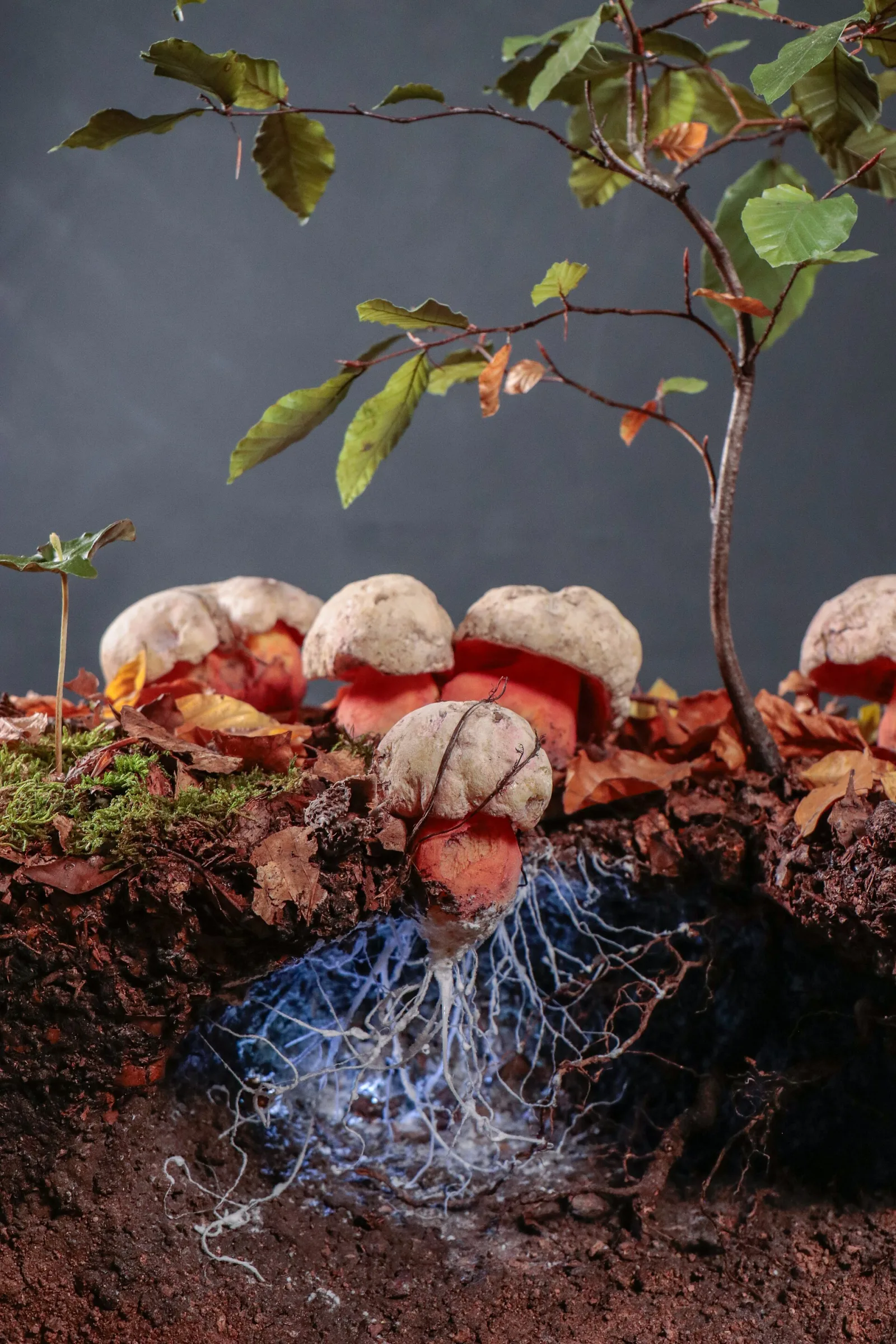
The association: resources in both directions
Arbuscular mycorrhizal fungi colonize roots and establish an exchange pathway: the plant supplies carbon derived from photosynthesis, and the fungus can transport soil nutrients, including phosphorus, nitrogen, and zinc. This describes the association; it does not guarantee that all plants receive the same amounts of each resource [310].
How hyphae help
Fungal hyphae extend from roots into the soil and increase contact between the root system and soil. This extension offers an explanation of how the fungus can contribute to water and nutrient uptake; the United States Forest Service synthesis highlights nitrogen and phosphorus in particular, but does not establish a universal magnitude for the effect [320, 323].
What tracing methods reveal
One way to test transport is to separate a soil compartment with a mesh that allows hyphae through but not roots, and label a nutrient there with an isotope. If the label later appears in the plant, this makes it possible to detect transport along the mycorrhizal pathway. These designs have been used to demonstrate transport in both directions, although the results apply to the conditions and organisms studied [310].
Do not confuse carbon entry pathways
Some of the carbon newly fixed by the plant can reach the soil through fungi associated with the root; another route is the direct release of compounds by the roots. A study comparing the two routes treats them as distinct processes related to nutrient availability. Therefore, not all carbon detected in the soil can simply be attributed to mycorrhizae [310, 311].
Variation and limits on what can be concluded
The exchange is not a fixed quantity that applies to every association. The review of tracer studies reports differences among cultivars: in wheat, the contribution of the mycorrhizal pathway to phosphorus depended on the variety; in barley, differences among cultivars in nitrogen transport were also described. These examples caution against turning the mechanism into a uniform promise for all plants and soils [310].
Interpretation and hypothesis, not a general conclusion
The interpretation supported here is limited: in the associations studied, the fungus can facilitate the transport of resources to the plant and receives carbon in return. Whether this capacity always contributes to the sustainability of natural or agricultural systems is a possibility that requires evaluation in specific contexts; the review notes that well-designed studies are needed to assess this potential [310].
Sources and method
This story synthesises the references below and separates possible observations from conclusions that would need more evidence. It does not present original FaunaGuide fieldwork or replace expert identification.
- Diversity of arbuscular mycorrhizal fungi in University of Port Harcourt, Port Harcourt in Southern Nigeria. — Diversity of arbuscular mycorrhizal fungi in University of Port Harcourt, Port Harcourt in Southern Nigeria. | The Bioscientist Journal Article Sidebar PDF Published: May 12, 2026 DOI: https://doi.org/10.54117/the_bioscientist.v14i2.212 Keywords: Mycorrhi
- Arbuscular mycorrhizal fungi contribute to wheat yield in an agroforestry system with different tree ages — Frontiers | Arbuscular mycorrhizal fungi contribute to wheat yield in an agroforestry system with different tree ages Intercropping achieved through agroforestry is increasingly being recognized as a sustainable form of land use. In agroforestry, the root
- Long-term N addition reduced the diversity of arbuscular mycorrhizal fungi and understory herbs of a Korean pine plantation in northern China — Frontiers | Long-term N addition reduced the diversity of arbuscular mycorrhizal fungi and understory herbs of a Korean pine plantation in northern China With the development of agriculture and industry, the increase in nitrogen (N) deposition has caused
- Track and trace: how soil labelling techniques have revealed the secrets of resource transport in the arbuscular mycorrhizal symbiosis. — Track and trace: how soil labelling techniques have revealed the secrets of resource transport in the arbuscular mycorrhizal symbiosis - PMC Arbuscular mycorrhizal (AM) fungi colonise plant roots, and by doing so forge the ‘mycorrhizal uptake pathway(s)’
- Exploring the transfer of recent plant photosynthates to soil microbes: mycorrhizal pathway vs direct root exudation. — Exploring the transfer of recent plant photosynthates to soil microbes: mycorrhizal pathway vs direct root exudation - PMC Plants rapidly release photoassimilated carbon (C) to the soil via direct root exudation and associated mycorrhizal fungi, with both
- Mycorrhizae and grapevines: the known unknowns of their interaction for wine growers' challenges. — Mycorrhizae and grapevines: the known unknowns of their interaction for wine growers’ challenges - PMC Arbuscular mycorrhizal fungi (AMF) play an important role in grapevine production systems. However, little is known about how this relationship is achie
- Mycorrhiza — A mycorrhiza (from Ancient Greek μύκης (múkēs) 'fungus' and ῥίζα (rhíza) 'root'; pl. mycorrhizae, mycorrhiza, or mycorrhizas) is a symbiotic association between a fungus and a plant, in which fungal hyphae and plant roots become interconnected and form an
- Mycorrhizal fungi and soil carbon storage — Soil carbon storage is an important function of terrestrial ecosystems. Soil contains more carbon than plants and the atmosphere combined. Understanding what maintains the soil carbon pool is important to understand the current distribution of carbon on E
- What are mycorrhizal fungi? | Kew — What are mycorrhizal fungi? | Kew Hidden beneath your feet, meet the fungi living within plant roots, and how Kew is studying these incredible species. 27 August 2025 7 min watch What are mycorrhizal fungi? Hidden beneath your feet, meet the fungi living
- Getting to the Root of the Solution - AgResearch Magazine — USDA ARS Online Magazine Vol. 54, No. 1 United States Department of Agriculture AgResearch Magazine ARS Home l About ARS l Contact ARS Search AgResearch Mag Jan 2006 - Contents PDF Previous Story Next Story Getting to the Root of the Solution Technician J
- Publication : USDA ARS — Publication : USDA ARS ARS Home » Northeast Area » Beltsville, Maryland (BARC) » Beltsville Agricultural Research Center » Sustainable Agricultural Systems Laboratory » Research » Publications at this Location » Publication #307387 ARS-wide ARS National P
- Mycorrhizae | US Forest Service Research and Development — Mycorrhizae | US Forest Service Research and Development T T T Articles Data and Tools Publications Treesearch Understory National Forest Service Library Multimedia Treesearch Mycorrhizae Informally Refereed Authors: Martin Jurgensen, Dana Richter, Carl C
- Mycorrhizae in forest tree nurseries | US Forest Service Research and Development — Mycorrhizae in forest tree nurseries | US Forest Service Research and Development T T T Articles Data and Tools Publications Treesearch Understory National Forest Service Library Multimedia Treesearch Mycorrhizae in forest tree nurseries Informally Refere
- Soil Fungi Critical to Organic Success - AgResearch Magazine — USDA ARS Online Magazine Vol. 49, No. 5 United States Department of Agriculture AgResearch Magazine ARS Home l About ARS l Contact ARS Search AgResearch Mag May 2001 - Contents PDF Previous Story Next Story Soil Fungi Critical to Organic Success Micrograp
- USDA ARS Online Magazine Vol. 58, No. 10 — USDA ARS Online Magazine Vol. 58, No. 10 United States Department of Agriculture AgResearch Magazine ARS Home l About ARS l Contact ARS Search AgResearch Mag Nov 2010 - Contents PDF Previous Story Next Story Infrared Sheds Light on Beneficial Microbes Inf
- How hidden fungi help us grow veg | Kew — How hidden fungi help us grow veg | Kew There's an underground world hidden in the soil which is essential for growing strong, healthy vegetables. 16 January 2020 3 min read How hidden fungi help us grow veg There's an underground world hidden in the soil
- Agricultura ecológica — La agricultura ecológica, orgánica o biológica es un sistema de cultivo de una explotación agrícola basada en la utilización óptima de los recursos naturales, sin emplear productos químicos sintéticos u organismos genéticamente modificados (OGMs) en ning
- Adventice — Une adventice (du latin adventicius, « qui vient de l'extérieur ») désigne pour les agriculteurs et les jardiniers, une plante qui pousse dans un milieu aménagé (champ, massif, etc.) sans y avoir été intentionnellement introduite. La terminologie populair
- Ecossistema — Um ecossistema, ou sistema ecológico, reúne os seres vivos de um lugar, o ambiente físico e as relações entre eles. Pode caber numa poça, num tronco em decomposição ou numa flowersta, e também pode abranger parte de um oceano. Seus limites dependem da perg
See and listen
Images, sounds and scenes
Resources that complement the information, with their origins and reuse conditions.
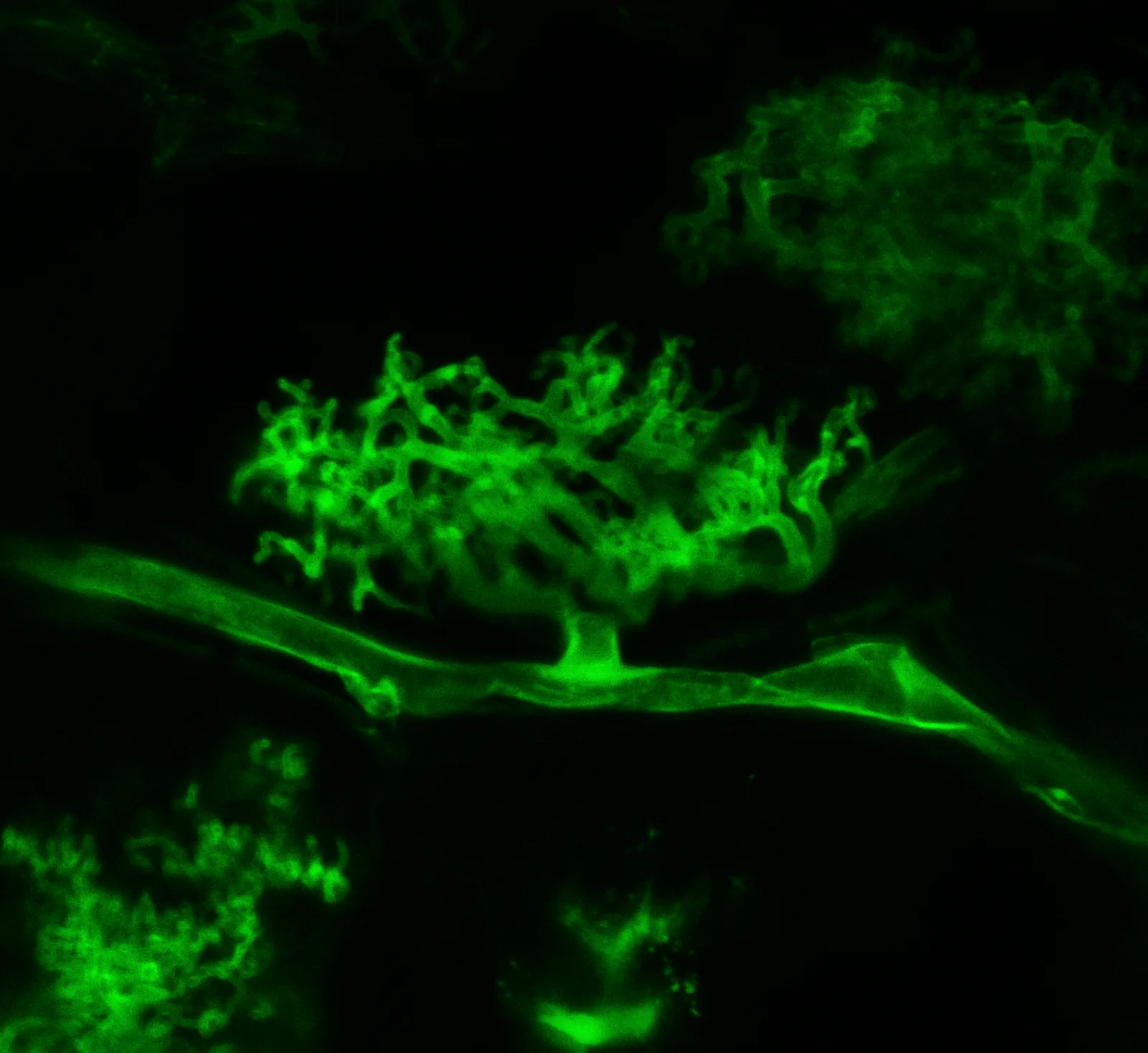
Documentary photograph: Arbuscular mycorrhizal fungi: resource exchange with roots