Report
Dead Wood Is Not Outside the Forest: It Is Habitat, Too
Standing trees and fallen logs can provide shelter and food. The available evidence, however, is regional and insufficient to establish a single management rule.
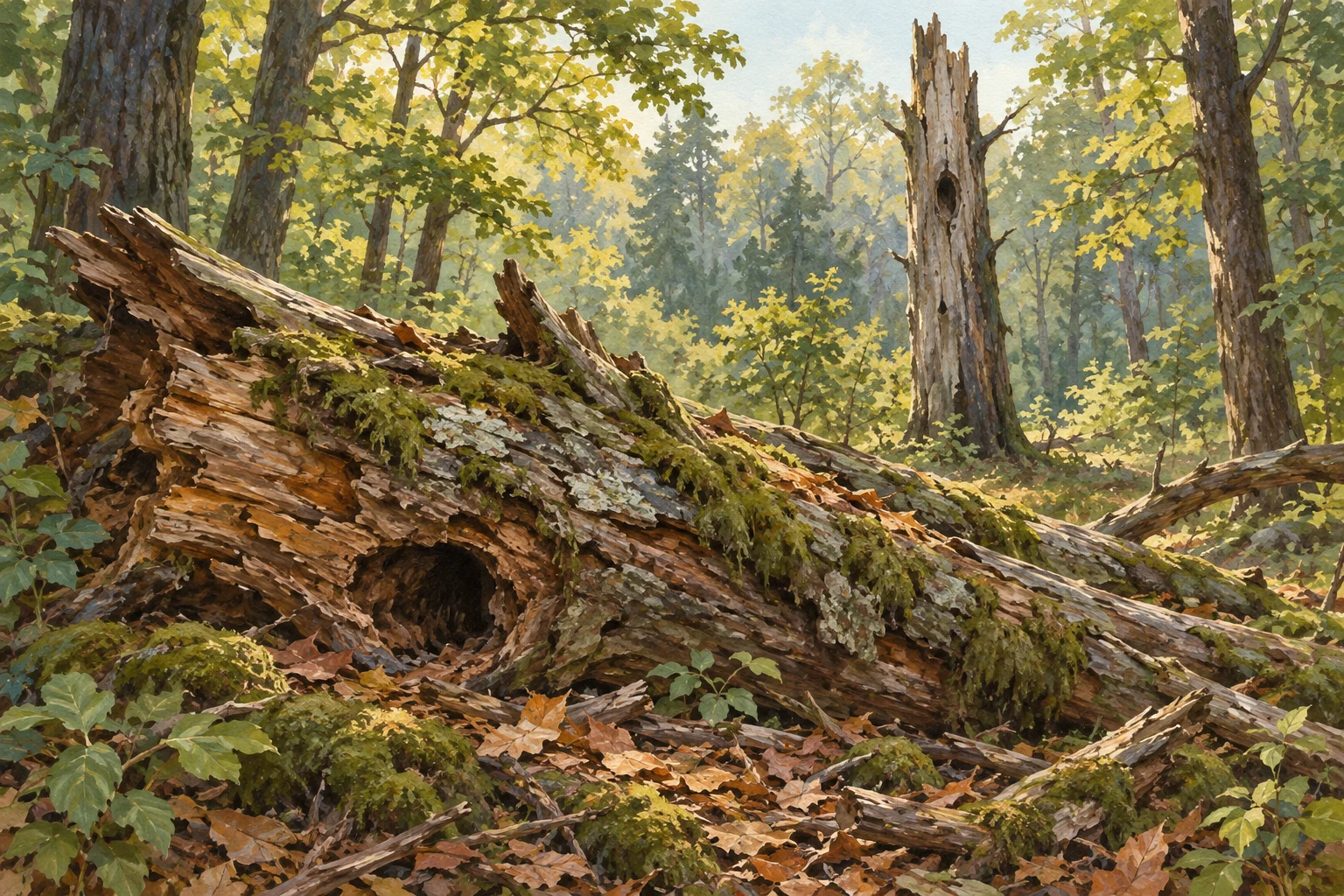
A Forest Does Not End When a Tree Falls
In a forest, dead wood is not just what remains of a tree: it can continue to be part of the habitat. The evidence available here supports a limited claim: standing dead trees and fallen coarse wood are used by various birds and mammals for nesting, resting, or foraging. On its own, it does not establish how much material is needed or what amount is suitable in any forest. [238]
Two Forms, Several Functions
The cited studies distinguish between standing dead trees—also called snags in English-language literature—and fallen coarse wood. The summary of a study from the Sierra Nevada states that birds and mammals use both forms for nesting, resting, or foraging. This is a description of habitat uses; the material available does not identify which specific species depend on each type or how much each contributes to their populations. [238]
When a Tree Falls, the Habitat Shifts
A research article published in PLOS One notes that the fall of standing dead trees can redistribute wildlife habitat and have consequences for the carbon cycle. It also warns that falling trees can affect public safety. The summary presents these consequences as ecological and practical reasons to study the phenomenon, but the supplied record does not allow the detailed results or their magnitude to be reconstructed here. [232]
A Tension That Cannot Be Resolved with a Number
The Sierra Nevada study addresses the implications of dead wood for habitat and fire hazard together. This shows that the topic involves objectives that may conflict; it does not demonstrate that there is a universally optimal amount or allow a conclusion from one region to be applied to another. Moreover, the available summary is truncated just as it begins to raise the problem of having too much dead wood. [238]
Region Matters
The sources cover different scales and places: one study concerns a mixed-conifer forest in the Sierra Nevada, while another describes regional patterns in forest habitats in Oregon and Washington. Their titles and records justify keeping these settings separate rather than treating them as a single sample of all forests. The material provided does not include enough detail from the Northwest study to summarize its patterns or compare them quantitatively with those in the Sierra Nevada. [238] [241]
What the Evidence Leaves Out
Fungi are part of the focus of a Forest Service publication titled “Dead wood, living legacies: habitat for a host of fungi.” However, the available excerpt does not provide enough results to explain which fungi use dead wood, how they use it, or under what conditions. For that reason, this text does not turn that relationship into a detailed ecological conclusion. [243] A review article about species that live in dead wood is included in the packet, but its full text is unavailable in the supplied record, so it is not used here as substantive support. [228]
A Deliberately Limited Conclusion
The evidence allows us to say that, in the cases described, dead wood serves habitat functions and that the fall of standing trees can change where that habitat is found. It does not allow us to set a general management recommendation, resolve the balance between habitat and fire hazard, or extrapolate the results to forests in other regions. [232] [238] [241]
Sources and method
This story synthesises the references below and separates possible observations from conclusions that would need more evidence. It does not present original FaunaGuide fieldwork or replace expert identification.
- Ecology of species living on dead wood – lessons for dead wood management — Jonsson B. G., Kruys N. et al. (2005) Ecology of species living on dead wood – lessons for dead wood management home focus and scope journal policies Focus and scope Peer review process Openness and transparency Publication frequency Archiving Article pro
- When a tree falls: Controls on wood decay predict standing dead tree fall and new risks in changing forests. — When a tree falls: Controls on wood decay predict standing dead tree fall and new risks in changing forests - PMC When standing dead trees (snags) fall, they have major impacts on forest ecosystems. Snag fall can redistribute wildlife habitat and impact p
- Long-term dead wood changes in a Sierra Nevada mixed conifer forest: habitat and fire hazard implications | US Forest Service Research and Development — Long-term dead wood changes in a Sierra Nevada mixed conifer forest: habitat and fire hazard implications | US Forest Service Research and Development T T T Articles Data and Tools Publications Treesearch Understory National Forest Service Library Multime
- Regional patterns of dead wood in forested habitats of Oregon and Washington. | US Forest Service Research and Development — Regional patterns of dead wood in forested habitats of Oregon and Washington. | US Forest Service Research and Development T T T Articles Data and Tools Publications Treesearch Understory National Forest Service Library Multimedia Treesearch Regional patt
- Wildfire-initiated dead wood legacies: Post-fire habitat and fuels trajectories in westside Pacific Northwest forests, USA | US Forest Service Research and Development — Wildfire-initiated dead wood legacies: Post-fire habitat and fuels trajectories in westside Pacific Northwest forests, USA | US Forest Service Research and Development T T T Articles Data and Tools Publications Treesearch Understory National Forest Servic
- Dead wood, living legacies: habitat for a host of fungi. | US Forest Service Research and Development — Dead wood, living legacies: habitat for a host of fungi. | US Forest Service Research and Development T T T Articles Data and Tools Publications Treesearch Understory National Forest Service Library Multimedia Treesearch Dead wood, living legacies: habita
- Healthy Forests Are Messy Forests (U.S. National Park Service) — Healthy Forests Are Messy Forests (U.S. National Park Service) Healthy Forests Are Messy Forests Official websites use .govA .gov website belongs to an official government organization in the United States. Secure .gov websites use HTTPSA lock ( ) or http