Natural-history
Fallen log: what the evidence allows us to say about the cycle of matter
A decaying log can offer a way to think about an ecosystem and the return of matter, but the available sources provide only a general framework: they do not document the seasonal course of a particular log.
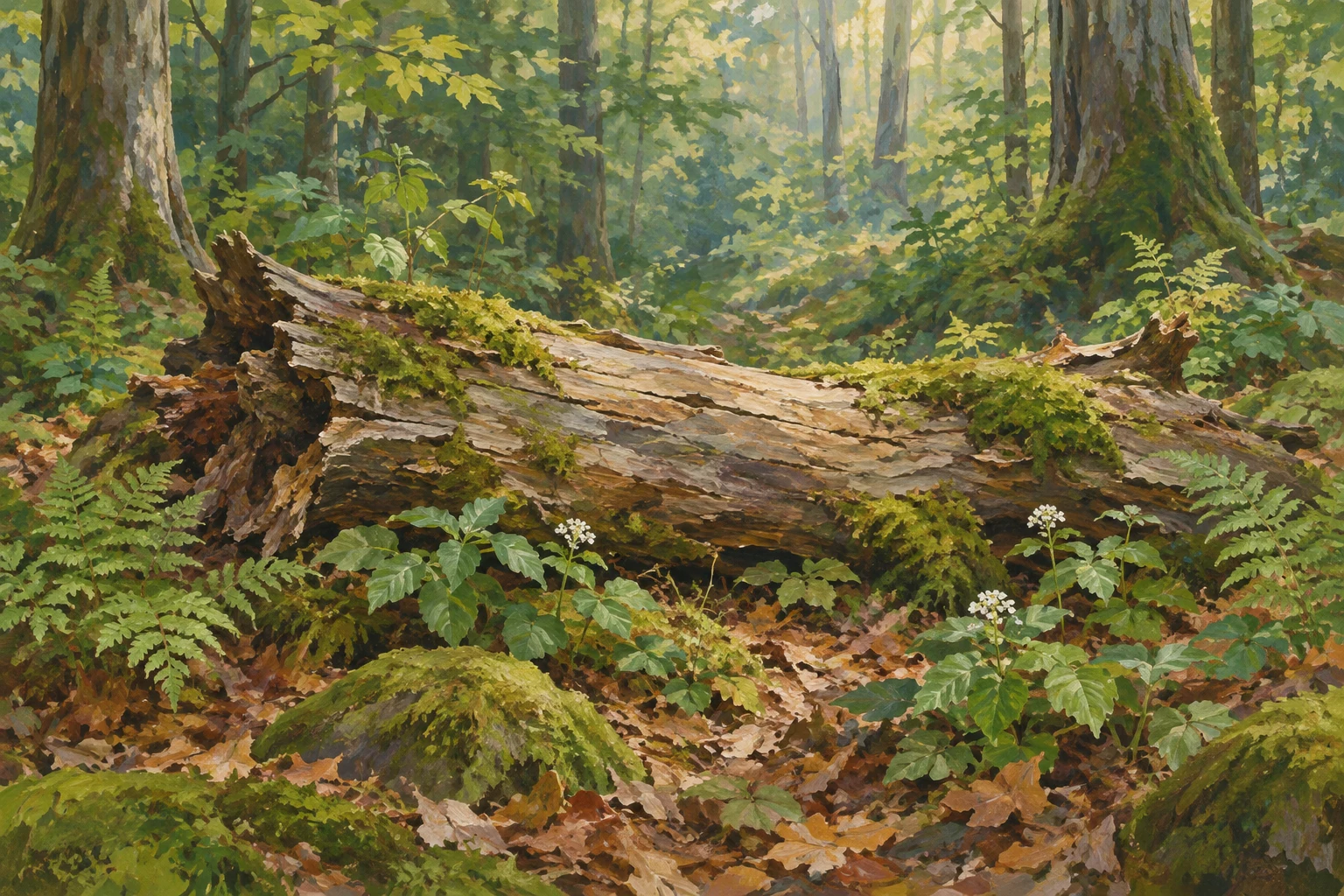
A miniature ecosystem, but not an observed story
A decaying log can be chosen as the boundary for studying an ecosystem: a set of living things, a physical environment, and the relationships between them. This possibility provides a framework for discussing matter, not a record of what happened to a particular piece of wood. The available sources contain no field observations, location, or species associated with a specific log. [1360]
From life to other forms of carbon
The carbon cycle describes a broad sequence: carbon used by living things is released after death and decomposition and may then be reused by another organism. Applied to a fallen log, this serves as a general explanation of the cycle, not as a measured account of how much carbon changes form or when this happens. [1377, 1379]
Decomposition returns nutrients to the surroundings
In the general ecological framework, decomposers transform remains and return nutrients to the environment. Biogeochemical cycles describe the circulation of elements between abiotic components and the organic substances of flora and fauna. The sources do not identify which organisms act on a particular piece of wood or detail the stages of that transformation in a specific log. [1360, 1378]
Matter circulates; energy does not return in the same way
It is useful to distinguish two processes that are often confused: elements such as carbon circulate in cycles, while energy passes through ecosystems and disperses as heat. This is a general distinction about ecosystems; the material consulted does not measure energy flows or describe their path through any particular fallen log. [1360, 1378]
No seasonal timetable has been established
The sources mention that seasons and the activity of organisms can transform ecosystems, but they do not provide a seasonal sequence for log decomposition. Therefore, it is not possible here to arrange stages by month, assign them durations, or say what changes first. Doing so would require specific information about the place and material studied. [1360]
A hypothesis, not the result of an observation
As a working hypothesis, the ecological history and relationships specific to each place could influence the route matter takes through a log. The source supports this idea for ecosystems in general, but does not show how it applies to fallen wood. The step from this broad principle to a particular case remains unverified. [1360]
The limits of this explanation
This text confines its scope to the conceptual framework: carbon returning to circulation, decomposers transforming remains, and nutrients returning to the environment. It does not establish a region, species, rates, quantities, or stages observed in a log. Telling the specific natural cycle of a log would require sources documenting that process; the available material does not provide them. [1360, 1377, 1378]
Sources and method
This story synthesises the references below and separates possible observations from conclusions that would need more evidence. It does not present original FaunaGuide fieldwork or replace expert identification.
- Árbol — Un árbol es una planta de tallo leñoso que se ramifica a cierta altura del suelo. El término hace referencia habitualmente a aquellas plantas cuya altura supera un determinado límite en la madurez, diferente según las fuentes: dos metros, tres metros,
- Carlism in literature — On March 21, 1890, at a conference dedicated to the siege of Bilbao during the Third Carlist War, Miguel de Unamuno delivered a lecture titled La última guerra carlista como materia poética. It was probably the first-ever attempt to examine the Carlist mo
- Ecossistema — Um ecossistema, ou sistema ecológico, reúne os seres vivos de um lugar, o ambiente físico e as relações entre eles. Pode caber numa poça, num tronco em decomposição ou numa flowersta, e também pode abranger parte de um oceano. Seus limites dependem da perg
- Cronologia da história da China — Esta é uma cronologia com a história da China. Entre as mudanças de dinastia, a maior parte das datas se sobrepõe, já que os períodos de reinado não são imediatamente transferidos. Datas anteriores a 841 a.C (início da regência Gonghe) são provisórias e s
- Círculo de bananeiras — O tratamento de efluentes por meio de Círculo de Bananeiras é um processo que engloba o tratamento complementar de efluentes provenientes de tanque séptico, bem como de disposição final de águas cinzas. Neste processo, o efluente é direcionado para uma va
- NAL Agricultural Thesaurus: NALT: ciclo de vida de los materiales — NAL Agricultural Thesaurus: NALT: ciclo de vida de los materiales Concept information ámbitos de estudio ciencia de la sostenibilidad ecología industrial ciclo de vida de los materiales recursos naturales, conservación, medio ambiente sostenibilidad ambie
- NAL Agricultural Thesaurus: NALT: inventario del ciclo de vida — NAL Agricultural Thesaurus: NALT: inventario del ciclo de vida Concept information ámbitos de estudio ciencia de la sostenibilidad ecología industrial evaluación del ciclo de vida inventario del ciclo de vida recursos naturales, conservación, medio ambien
- NAL Agricultural Thesaurus: NALT Core: ciclo del carbono — NAL Agricultural Thesaurus: NALT Core: ciclo del carbono Concept information ámbitos de estudio ciencia del sistema terrestre ciclos biogeoquímicos ciclo del carbono ámbitos de estudio geología geoquímica biogeoquímica ciclos biogeoquímicos ciclo del carb
- NALT: ciclos biogeoquímicos - NAL Agricultural Thesaurus — NAL Agricultural Thesaurus: NALT: ciclos biogeoquímicos Concept information ámbitos de estudio ciencia del sistema terrestre ciclos biogeoquímicos ámbitos de estudio geología geoquímica biogeoquímica ciclos biogeoquímicos ámbitos de estudio química geoquí
- NAL Agricultural Thesaurus: NALT: ciclo del carbono — NAL Agricultural Thesaurus: NALT: ciclo del carbono Concept information ámbitos de estudio ciencia del sistema terrestre ciclos biogeoquímicos ciclo del carbono ámbitos de estudio geología geoquímica biogeoquímica ciclos biogeoquímicos ciclo del carbono á
- NAL Agricultural Thesaurus: NALT: ciclo del ácido cítrico — NAL Agricultural Thesaurus: NALT: ciclo del ácido cítrico Concept information ámbitos de estudio bioquímica vías bioquímicas ciclo del ácido cítrico Término preferido ciclo del ácido cítrico Tipo Topic Concepto genérico vías bioquímicas Conceptos relacion
- Ciclo de Rocas - Teachers (U.S. National Park Service) — Ciclo de Rocas - Teachers (U.S. National Park Service) Ciclo de Rocas Official websites use .govA .gov website belongs to an official government organization in the United States. Secure .gov websites use HTTPSA lock ( ) or https:// means you've safely co