At a glance
Essentials
- Size
- Adults are usually approximately 15–25 cm in total length, although larger individuals have been recorded. The range may vary with age, sex and population.
- Distribution
- It is distributed across broad areas of central and southern Europe; sources describe its presence at a regional scale, without implying that it continuously occupies the entire area.
- Habitat
- In central and southern Europe, it occupies cool, moist woodland environments, often near streams, springs, or ponds where larvae can develop.
- Activity
- It is primarily nocturnal; it may be active during the day in wet or rainy conditions.
- Diet
- Adults consume invertebrates such as earthworms, mollusks, and insects; larvae feed on small aquatic animals.
Observation guide
What to look for
- 01
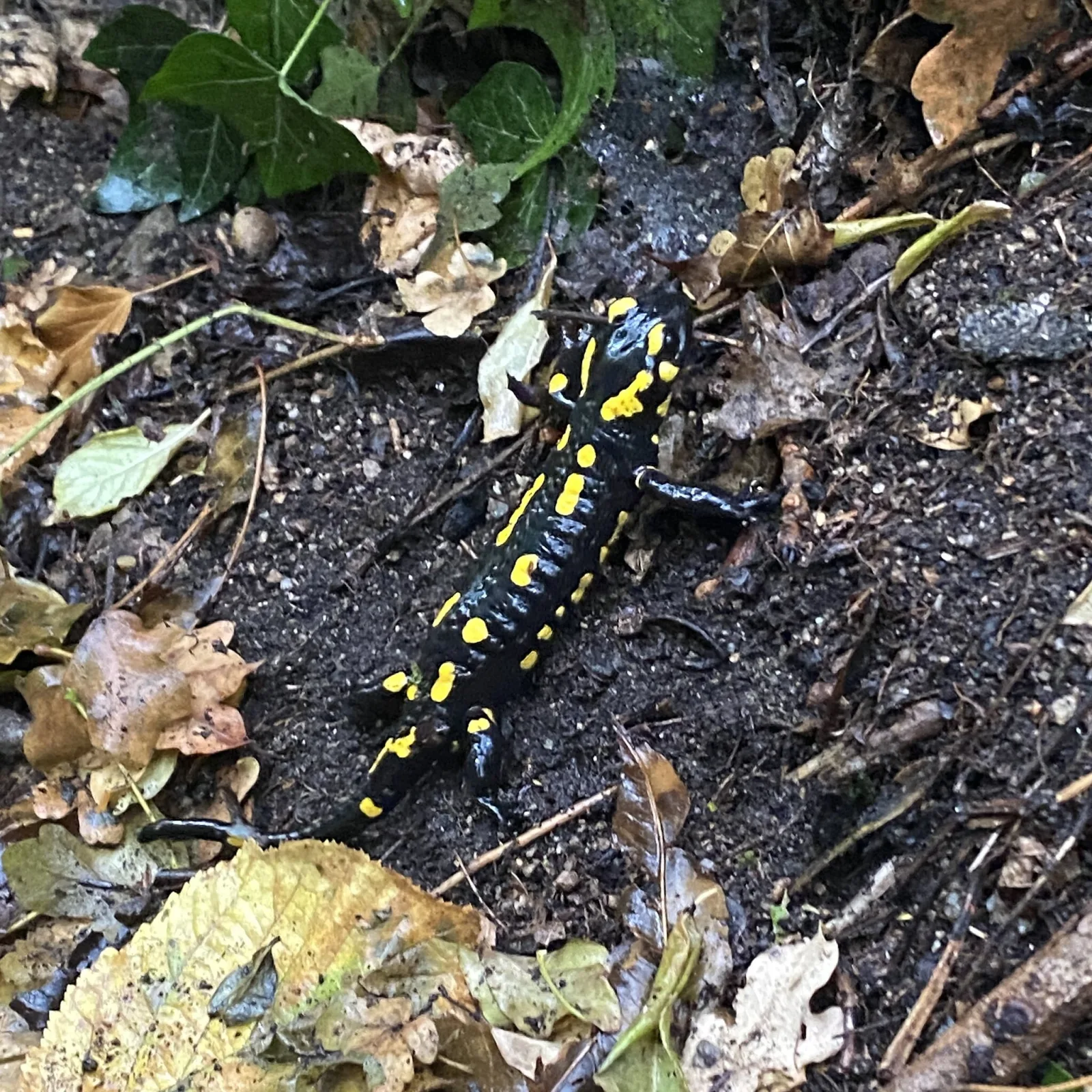
Yellow or orange markings on a black background, with variable patterns of spots or bands.
- 02
Visible parotoid glands on the head, behind the eyes.
- 03
Robust body and relatively short tail, with no dorsal or caudal crest.
Lighting, age and viewing angle can hide features. If identification affects consumption, handling or conservation, consult specialist sources.
Ecology
Description and characteristics
The contrasting coloration is the most striking feature of Salamandra salamandra: the body is usually black with yellow or orange spots, arranged as dots, large patches, or bands. The pattern varies considerably among individuals and populations, and reddish tones sometimes occur. It has a robust body, a relatively short tail, and visible parotoid glands behind the eyes; it lacks dorsal and caudal crests. Adults are usually approximately 15–25 cm long, although some sources record larger individuals. Females tend to be somewhat larger than males. The bright coloration functions as a warning signal, and skin secretions help defend against predators.
In central and southern Europe, the species occurs in cool, moist woodland environments, often in broadleaf forests and near streams, springs, ponds, or other water sources suitable for larval development. During the day it usually hides under stones, logs, leaf litter, or in crevices, refuges that help conserve moisture. It is primarily nocturnal and may be active during the day in wet or rainy conditions. Adults are mainly terrestrial, while larvae live in water, in small watercourses and other suitable aquatic habitats. Moist skin contributes to respiration in adults; larvae breathe through gills.
The transition from aquatic larva to terrestrial adult shapes its life cycle. Fertilization is internal, and the embryos develop inside the female; in many populations, she deposits developed larvae in water, often in suitable places along the banks. The larvae have external gills and four limbs; as they grow, they undergo metamorphosis, during which the gills disappear and they acquire the terrestrial life of the adult. Diet varies by life stage: larvae consume small aquatic animals, while adults eat terrestrial invertebrates, including earthworms, mollusks, and insects. Thus, the availability of moist refuges on land and suitable waters for larvae links the different environments the species needs.