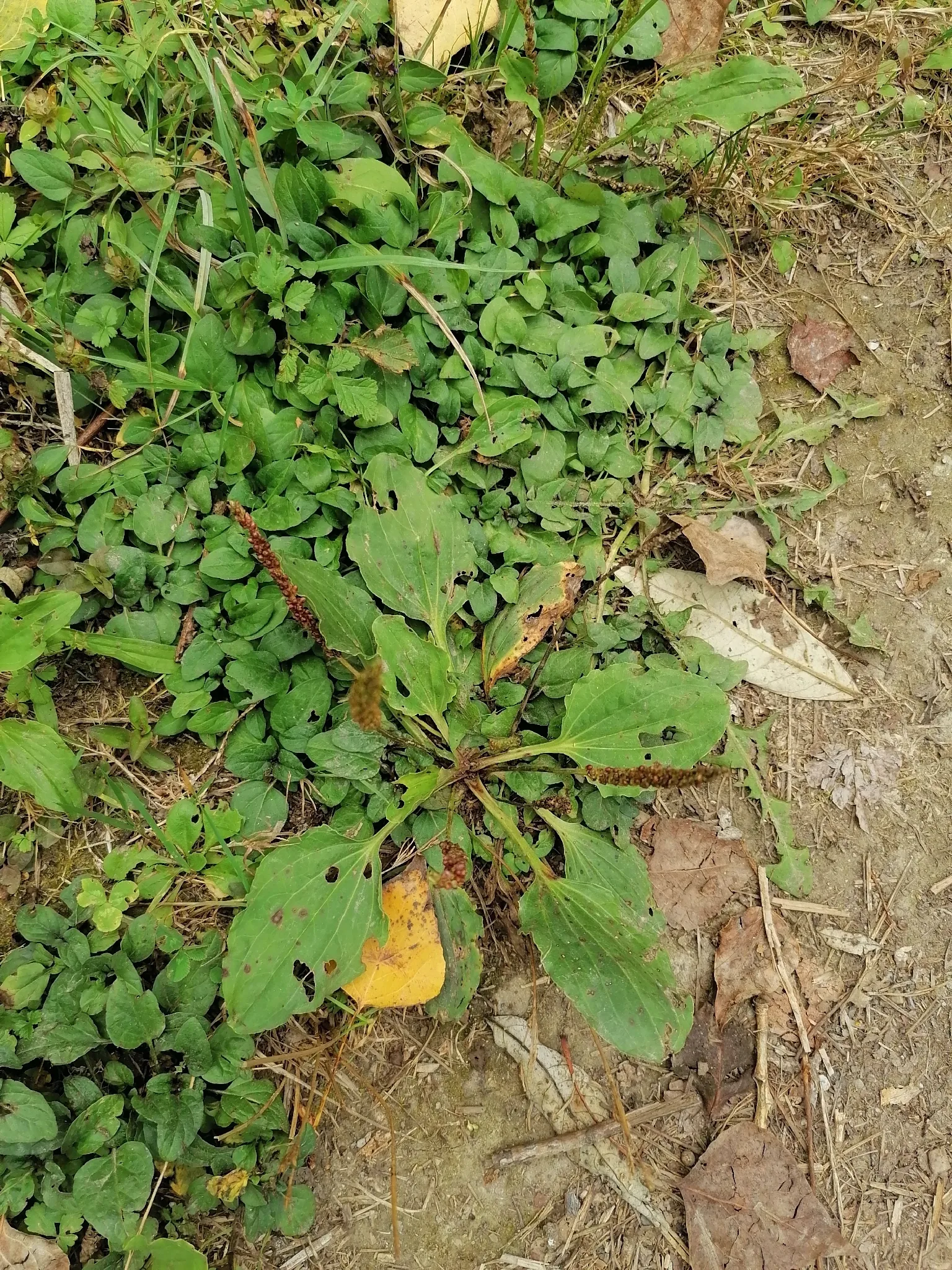
At a glance
Essentials
- Distribution
- Its native range includes Eurasia. It has become widely naturalized in other regions of the world.
- Habitat
- Grows in meadows, fields, lawns, roadsides, and other disturbed places; it tolerates compacted soils and trampling.
Observation guide
What to look for
- 01
Basal rosette of broad, oval or elliptic leaves.
- 02
Prominent longitudinal veins running along the leaves from the base.
- 03
Dense, elongated spikes of small flowers, borne on flowering stems.
Lighting, age and viewing angle can hide features. If identification affects consumption, handling or conservation, consult specialist sources.
Ecology
Description and characteristics
Plantago major is a perennial herb that forms a rosette of basal leaves. The leaves are oval to elliptic, with a distinct petiole and several prominent longitudinal veins; their margins may be entire or irregularly toothed.
Its small flowers are grouped in dense, elongated, unbranched spikes borne on flowering stems. Pollination is by wind, and the fruit is a capsule containing small seeds; a plant can produce up to 20,000 seeds.
It is a species tolerant of soil disturbance and trampling. It occurs in meadows, fields, lawns, and roadsides, as well as in other places disturbed by human activity.