Report
Why Ecological Corridors Matter: Connecting Does Not Guarantee
Connectivity can facilitate wildlife movement between fragmented habitats and help species respond to environmental change. But the evidence available here mainly explains this mechanism and offers studies from specific regions; it cannot establish how much each corridor benefits biodiversity.
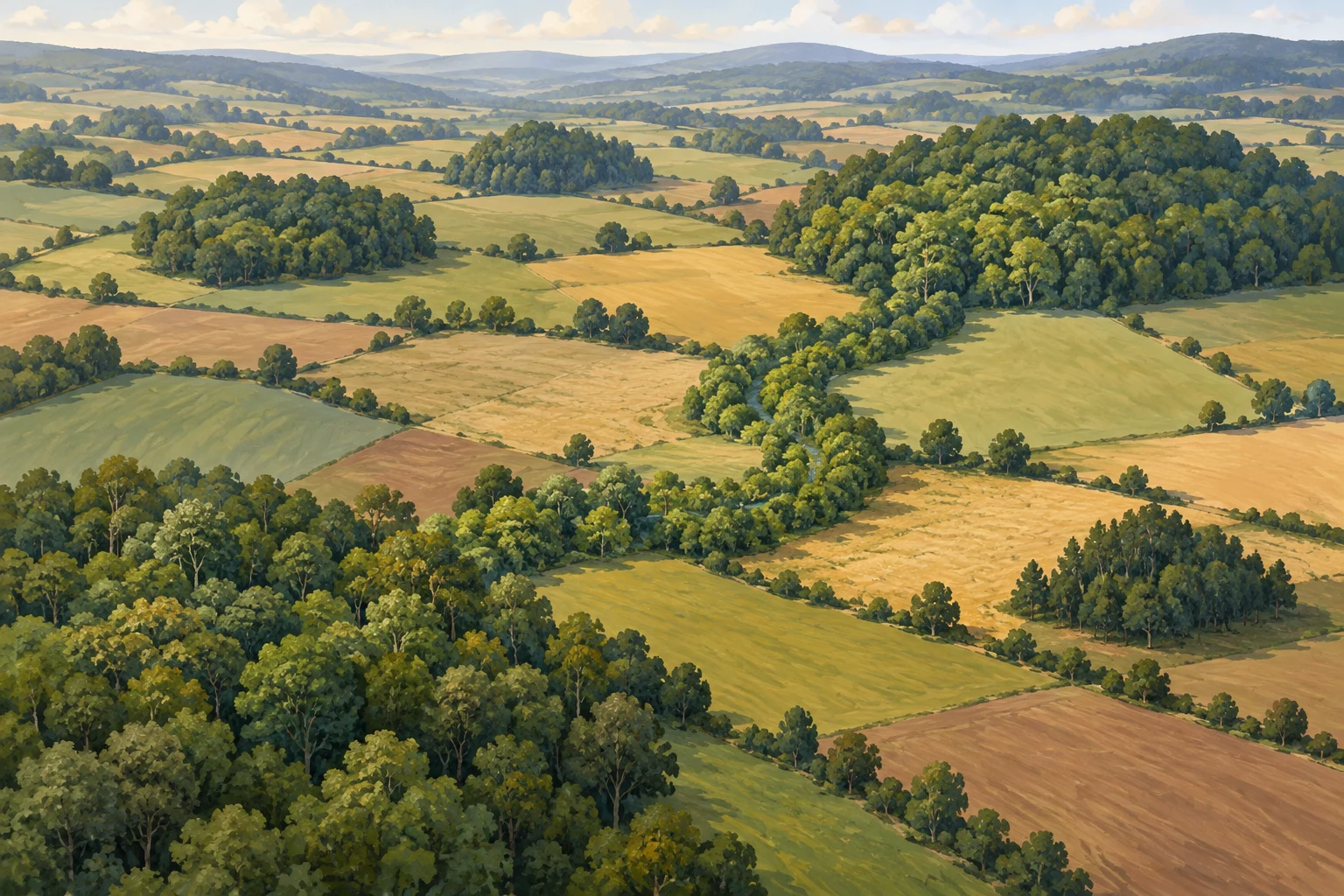
The value of preserving movement options
An ecological corridor matters, first and foremost, because habitats do not always function as isolated units. Connectivity refers to the degree of movement of organisms or processes between habitat patches; in transformed landscapes, roads and urban areas can obstruct those movements. [564] The idea is not that a connected strip can, by itself, solve biodiversity loss, but that it may preserve routes and options that fragmentation reduces.
What the ecological explanation proposes
The explanation is functional: facilitating the movement of species and natural processes through fragmented or altered landscapes can support the dynamic adaptation of ecosystems and help reduce biodiversity loss. The European Environment Agency presents connectivity as relevant both to addressing changes in land use and to responding to climate change, in terrestrial and marine environments as well as agricultural and urban settings. [558] These are expected benefits of connectivity, not a guarantee that any corridor will produce these outcomes.
A question being studied in California
In Southern California, a US Geological Survey project addresses connectivity in landscapes modified by people, using landscape genetics for mule deer and road-crossing rates for deer and carnivores at links considered key. [564] This description establishes what is being investigated; the information available here does not report results that would allow us to say how much these animals move or whether the links studied improve their survival or reproduction.
An additional reason: changing landscapes
Connectivity is also presented as a climate adaptation tool. In 2021, the US Geological Survey described a set of tools developed with state and federal agencies to guide the creation of connected landscapes and account for climate change. [563] Climate-ADAPT, in turn, notes that facilitating movement can support ecosystem adaptation to changes in climate and land use. [558] The convergence of these sources supports the importance of including connectivity in planning; it does not demonstrate that a specific measure is effective everywhere.
The landscape and coexistence matter too
Corridors do not exist apart from communities or conflicts over land use. A 2021 article on the foothills of the western Himalayas in India suggests that escalating human-wildlife conflict can hinder the conservation of ecological corridors. [549] The available excerpt does not present the results of the incentive strategy announced in the title, so its effectiveness cannot be judged. The limited lesson that can be drawn is that connectivity can face social and economic barriers as well as physical ones.
Different regions, different conclusions
The available examples do not amount to a global assessment. The study on California focuses on links and roads in an urban landscape; the work on the Himalayas concerns coexistence between large mammals and people; and the European guidance covers ecological networks in diverse types of environment. [564] [549] [558] The Lower Rio Grande Valley, on the border between the United States and Mexico, illustrates another context: a transition between temperate and tropical conditions that supports a great diversity of plants and animals. [562] That regional biological importance does not, by itself, prove that a specific corridor has increased connectivity.
The promise and limits of the evidence
The rationale for preserving connections is plausible and supported as a planning principle: enabling movement between habitats can sustain ecological processes and provide room to respond to changing landscapes. [558] But the sources gathered here do not quantify a general effect on biodiversity or compare the benefits of specific corridors with their costs or alternatives. To avoid confusing a management hypothesis with a demonstrated outcome, it is useful to distinguish between designing for connectivity and measuring which species use it and with what consequences.
Sources and method
This story synthesises the references below and separates possible observations from conclusions that would need more evidence. It does not present original FaunaGuide fieldwork or replace expert identification.
- An incentive-based mitigation strategy to encourage coexistence of large mammals and humans along the foothills of Indian Western Himalayas. — An incentive-based mitigation strategy to encourage coexistence of large mammals and humans along the foothills of Indian Western Himalayas - PMC Escalation of human–wildlife conflict (HWC) is a barrier to the conservation of ecological corridors across t
- Enhancing Ecological Networks | Adaptation options | Discover the key services, thematic features and tools of Climate-ADAPT Climate-ADAPT — Enhancing Ecological Networks Enabling species migration and movement in the natural environment supports dynamic adaptation processes in ecosystems, reduces biodiversity loss and preserves ecosystem services. Adaptation OptionEnhancing Ecological Network
- An international borderland of concern: Conservation of biodiversity in the Lower Rio Grande Valley — An international borderland of concern: Conservation of biodiversity in the Lower Rio Grande Valley The Lower Rio Grande Valley (LRGV) of southern Texas is located on the United States-Mexico borderland and represents a 240-kilometer (150-mile) linear str
- New Toolkit Helps Managers Create Connected Landscapes Robust to Climate Change | U.S. Geological Survey — New Toolkit Helps Managers Create Connected Landscapes Robust to Climate Change Connecting fragmented landscapes is a key conservation tool for ensuring the long-term health and survival of otherwise isolated plant and animal species. The Association of F
- Evaluation of Connectivity for Wildlife in Human-altered Landscapes: Mule Deer Landscape Genetics and Highway Crossing Rates for Deer and Carnivores at Key Southern California Linkages | U.S. Geological Survey — Evaluation of Connectivity for Wildlife in Human-altered Landscapes: Mule Deer Landscape Genetics and Highway Crossing Rates for Deer and Carnivores at Key Southern California Linkages Wildlife must navigate the confusing maze of disconnected habitats and
- Project Spotlight: Working Together Towards a Conservation Landscape of the Future | U.S. Geological Survey — Project Spotlight: Working Together Towards a Conservation Landscape of the Future Southeast CASC Research Ecologist Adam Terando's urbanizations models predict a future in the American Southeast characterized by concrete, development, and fragmented land