At a glance
Essentials
- Distribution
- The stated native range includes northern and central America and temperate and subtropical regions of the Old World; geographic extent may vary between regions.
- Habitat
- Lives floating in fresh waters; recorded in various aquatic habitats, often in somewhat eutrophic waters, and on ponds at cooler elevations in East Africa.
Observation guide
What to look for
- 01
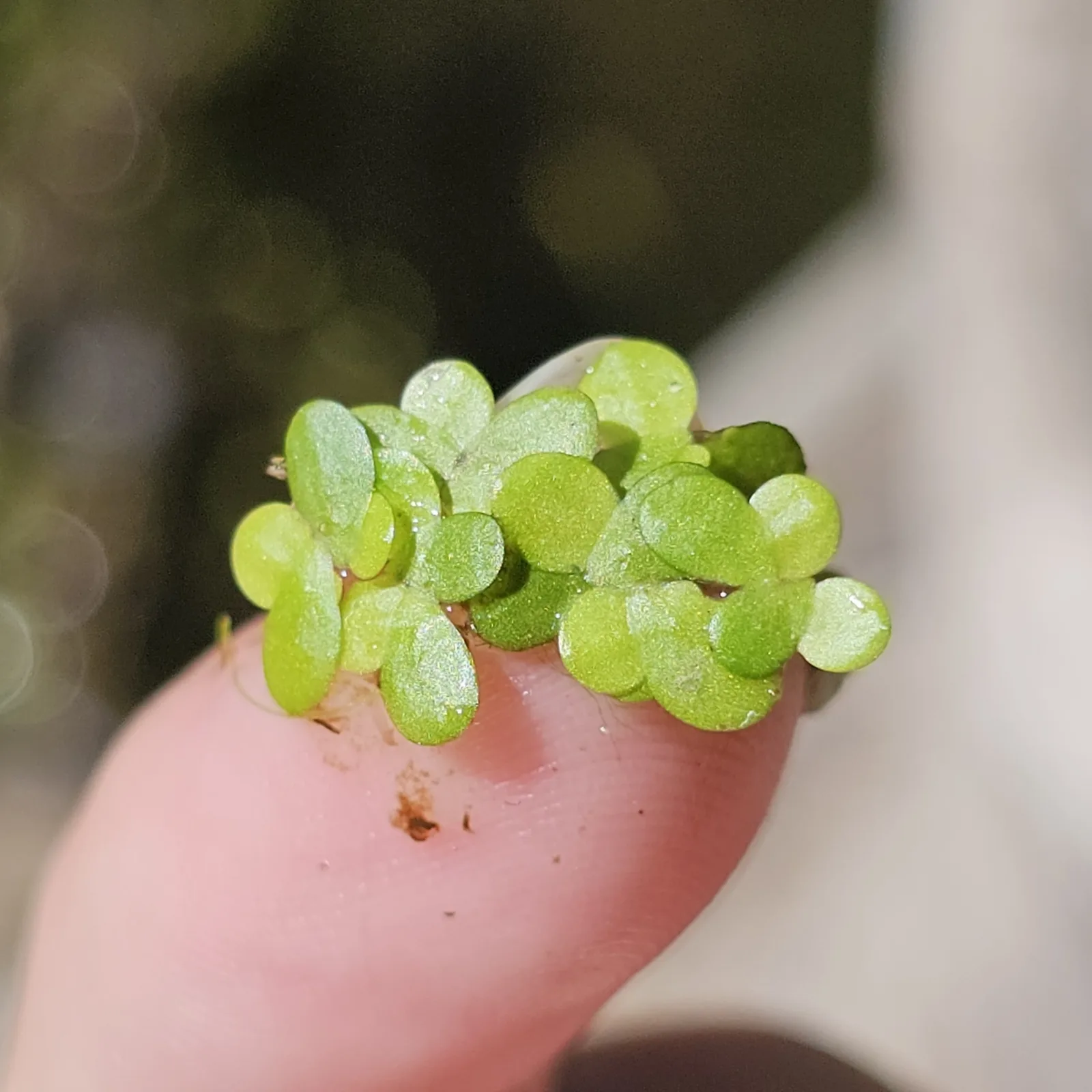
Small flat, oval fronds, generally 2.5–6 mm long and 1.5–4 mm wide.
- 02
Thallus usually dark green, symmetrical, and with three faintly visible veins.
- 03
Each frond bears a single root, which emerges beside a groove; its sheath has no wings.
- 04
The upper surface may be glossy and occasionally reddish, with a more intense hue than the lower surface.
Lighting, age and viewing angle can hide features. If identification affects consumption, handling or conservation, consult specialist sources.
Ecology
Description and characteristics
Lemna minor is a small floating aquatic plant. Its vegetative body, called a thallus or frond, is flat, symmetrical, and oval to oblong in outline; it usually measures 2.5–6 mm long and 1.5–4 mm wide. It is dark green and has three faintly marked veins. No large air spaces are visible underneath. A single root grows from each frond, emerging beside a shallow groove; the sheath surrounding it has no wings, and the root tip is blunt or, generally, rounded. The upper surface may be glossy and can sometimes show a diffuse reddish tinge, especially in the cold season; if the lower surface develops some red coloration, it is usually much less intense.
It grows on the surface of fresh waters, where its fronds float without being attached to the bottom. It occurs in various aquatic environments and may be found in waters somewhat enriched with nutrients. A description from East Africa places it on the surface of ponds at cooler elevations, up to about 1,800 m; this figure applies to that region and does not define a global elevation limit. The species develops mainly in temperate biomes and is described as hydroannual. Under favorable sunlight and temperature conditions it can multiply rapidly, although the available information does not specify the mechanism of propagation here or support attributing a constant growth rate to it.
Sexual reproduction is documented, but reproductive structures are not usually observed: the inflorescence appears occasionally and fruits are produced rarely. The floral structure comprises a solitary female flower and two male flowers, each with one stamen; the flowers are located in a lateral cavity open at the top. When formed, the fruit contains a single seed. These documented traits make it possible to recognize an infrequent reproductive phase, without implying that flowers or fruits must be produced for floating fronds to be observed. Kew’s stated native range includes northern and central America and temperate and subtropical areas of the Old World.